James Coghlan's F1 Blog

8 July 2013

Deutschland uber alles: Vettel' imperious win in Germany and mid-season review

                                                                                                                                Source: motorsport.com

The home favourite Sebastian Vettel produced an inspiring win to fend off the Lotuses of Kimi Raikkonen and Romain Grosjean. The three-times world champion placed his stamp on victory very early on by passing the pole-sitter Lewis Hamilton at the first corner, with teammate Mark Webber making it a one-two in as little time. Webber sustained the challenge to Vettel until his first pit-stop, in which a faulty wheelgun caused the right rear tyre to fly off and strike FOM cameraman Paul Allen, who suffered a broken shoulder and cracked ribs. He was subsequently taken to Koblenz Hospital, where he is currently under observation. Webber recovered with a sterling drive to go from twenty-first to seventh by the chequered flag.

The Lotuses of Kimi Raikkonen and Romain Grosjean maintained pressure on the lead throughout the race, both producing strong drives to lock out the podium. Raikkonen became held up behind slower cars after his first pit-stop, but managed to haul Vettel in after a final stop nine laps before the end.

Ferrari-having demonstrated a distinct lack of pace throughout the weekend-endured a somewhat torrid race with Felipe Massa suffering an unusual spin at the end of the third lap, stalling his engine in the process. Fernando Alonso struggled with the car to take it up to fourth by the safety car period in the middle of the race. He stayed there until the end, unable to pass Grosjean with five laps remaining due to the Frenchman's strict unstructions to keep the Spaniard behind as well as depleted soft tyres, thus allowing Raikkonen to close the 2.5 second gap to Vettel.

Mercedes, yet again, remained fairly incognito during the race, with Hamilton plummeting from pole to finish fifth in a drive burdened by excessive rear tyre wear. Rosberg endured the same issue, finishing ninth after failing to improve on a poor qualifying.

This race seemed to send out an ominous message to the front-running few, as Vettel stormed away with his fourth victory in nine races- a statistic no other driver can hold a candle to. Whilst the positions of the leaders seem to change every meeting, Vettel and Red Bull are always in the centre frame; he hasn't finished lower than fourth throughout the season. They are doing a fantastic job, and have opened up a daunting lead of sixty-seven points in the constructors championship, not to mention the thirty-four point lead enjoyed by Vettel. So far they haven't seemed to struggle on any weekend, and look pretty handy for a fourth double-championship in a row.

Lotus seemed to have picked up where they left off towards the beginning of the season. Their pace was undeniably hindered halfway through, with both Raikkonen and Grosjean pointing the finger at the safety car for not securing the top step. It wasn't hard to notice this during the race, seeing Grosjean's immense speed early on and the rate at which Raikkonen was catching Vettel towards the end. This performance may have been a one-off, but people can't forget the fact that Pirelli have altered the rear tyres to make them stronger. Lotus have been able to manage their tyres fantastically well this year, so they need to be watched out for in the coming races.

Conversely, Mercedes desperately need to sort out their race pace. Despite participating in a somewhat controversial tyre test in the run-up to Montreal, high rear tyre wear is still inhibiting their ability to stick the car on the podium. The fact is even more heartbreaking when one looks at their pace in qualifying, when not even Vettel in a Red Bull can touch them. Rosberg has got half a monkey off his back by securing wins at arguably the two most prestigious venues, but Hamilton has yet to fully silence the sceptics who questioned his move. Will he get that elusive first win soon? Not if his Pirellis have anything to say about it.

6 July 2013

Tortured tyres: Pirelli and the start of the European season

Worn Pirelli tyres in parc ferme
Source: motorsport.com
After the end of the 2010 season, not many people believed that racing could get any closer or more exciting. However, wind the clock back to the pre-season period and the picture was very different indeed: the days of re-fuelling in Formula 1 were at an end for the foreseeable future, and were pre-emptively mourned by a great number of die-hard fans. Similar to the ending of the V10 era, many fans simply weren't satisfied, and expected the pinnacle of motorsport to experience an unsavoury dilution. Boy, were they wrong. Not only did 2010 produce one of the most widely-inclusive and closely-fought title battles in years, it also nurtured the rise of the youngest world champion in the sport's history. Yep, I think that was a fairly decent year. Was Formula 1 satisfied? Of course not, and we shouldn't have expected anything less.

Nevertheless, Bridgestone's decision to pull out of motorsport's hottest seat came as a surprise, especially since racing was so exciting. Their reason? To 'redistribute [the company's] resources as part of a changing business strategy'. In other words, they were running out of time and money for Formula 1. A shame indeed, but Bernie Ecclestone saw it differently. On the one hand, the motorsport fanatic in him saw an opportunity to fully exploit the potential of the world's finest racing cars. But on the other hand, as is so often the case, the greedy little gremlin that is him saw an opportunity to make a butt-load of cash. And so, armed with the mandate to make Formula 1 even more exciting and unpredictably mental, Pirell set out to create tyres which would promote less tactically-oriented racing. Well, judging from the start of the European leg of the 2013 season, I'd say the fans' premonitions are nearing realisation. However, I wouldn't say they were for the precise reasons they were bemoaning: in an astonishing series of events from the Spanish GP to last weekend's manic race at Silverstone, Pirelli's tyres have managed to "go from being a nuisance to being downright dangerous", in the words of the automotive sage Jeremy Clarkson (only he was describing a somewhat battered Lancia Beta Coupe. Perhaps it's an Italian thing?).

Where on earth do I start? The saga seemed to have been in full swing by the weekend of the Spanish GP in May on the back of tyre failures in both Malaysia and Bahrain, which sparked intrigue but not a huge amount more. The race itself seems to have had all the ingredients required for an emotionally-charged event, with Fernando Alonso performing a stunning set of moves on the first lap to move up into third place, and subsequently storming past Nico Rosberg on lap 13 to take the lead. That is where he stayed, and the Spanish fans went crazy for him. Let's get one thing straight: this was not an exciting grand prix. It may have been exciting from Alonso's viewpoint (and who can blame him), but for the rest of us it was really rather astonishing to watch. Both of the Mercedes dominated qualifying, but were left floundering for position in the race. Lewis went from 2nd on the grid to finish 12th. Dropping ten places is not fun for a driver to endure, let alone the heartbroken fans who had sadly come to expect nothing less of Mercedes' race pace. Rosberg wasn't much better, as he went from pole to finish 6th. This is a guy who is renowned for being blisteringly quick and knowing how to nurse a tyre. In all honesty, you may be forgiven for thinking he was having a nap.

Alright, you may be thinking, Mercedes' race pace has been off for a few years now due to an irritating and inexcusable ability to keep its tyres fresh(ish), so it's no wonder they struggled on such an arduous circuit. But when you looked at Ferrari and Lotus, Massa and Raikkonen, and even Vettel and Webber, you could see they weren't trying to race the nuts off their cars. Massa catching Raikkonen in the closing stages of the race was a prime example of this: the prospect of a dramatic climax was looking likely (not for the win, mind), but his Pirellis decided something more akin to a funeral procession would be better. Needless to say, he backed off without a fight. So did Vettel, who said that he "just didn't have the tyres to fight with the guys in the front". That's not 'the speed', that's 'the tyres' (but Formula 1 should be mostly about speed, right Bernie?). All became clear when Red Bull boss Dietrich Mateschitz marched straight up to the multi-billionaire after the race and declared that "Formula 1 is nothing to do with racing any more", and that "we can't get the best out of our car". If that isn't a wake-up call I don't know what is. I'm all for strategy in Formula 1- without it, the sport would be very processional. But drivers not trying in Formula 1 is like a rockstar not playing their guitar at a concert-it's completely pointless. Frankly, they may as well be driving around on lawnmowers.

Yes, you probably thought ten days later, Monaco. Surely Pirelli's strategy of mitigating processional driving would pay dividends on a track as narrow as in Monte Carlo? As the many millions who tuned in stared in disbelief, Pirelli's tyres were causing absolute chaos. Obedient and innocent as ever, they were doing just as Mr Ecclestone had asked by providing tyres which wouldn't last more than a third of race distance at the very most. Well done, minions. However, providing tyres that cause drivers to drive so slowly that the entire field bunches up and collides is appalling and extremely dangerous. The front-running drivers were clearly playing the political long-game: driving slowly, preserving tyres and securing points. That's fine, Pirelli, but when the front-running drivers (incidentally the best of their type in the world, if you didn't notice) play this game to such an extent that desperados like Sergio Perez can bully them into letting them past is, quite frankly, tragic. On a track of such huge significance as Monte Carlo streets, only the creme de la creme of motorsport should be able to have the honour of thrashing the fastest racing cars around at insanely high speed. Unfortunately, one of the more stubborn members of this elite refused to play ball, and as a result a nasty crash ensued. From this, one could come to the conclusion that if Formula 1 racing is conducted in the way it should be (i.e. at the highest limit of speed and grip), Pirelli is making the sport dangerous. Not exciting, but dangerous. You only had to look at the way Alonso was driving to tell that the drivers are not only being prevented from exhibiting their enormous talent, but are actually driving in such a way so as to avoid an incident. To add insult to injury, when drivers such as Perez and Grosjean try to put on a good show and go for an overtake, as they rightly should, red flags suddenly appear. It isn't right. Not for the drivers, not for the fans, not for anyone. How good is Pirelli's PR strategy looking now?

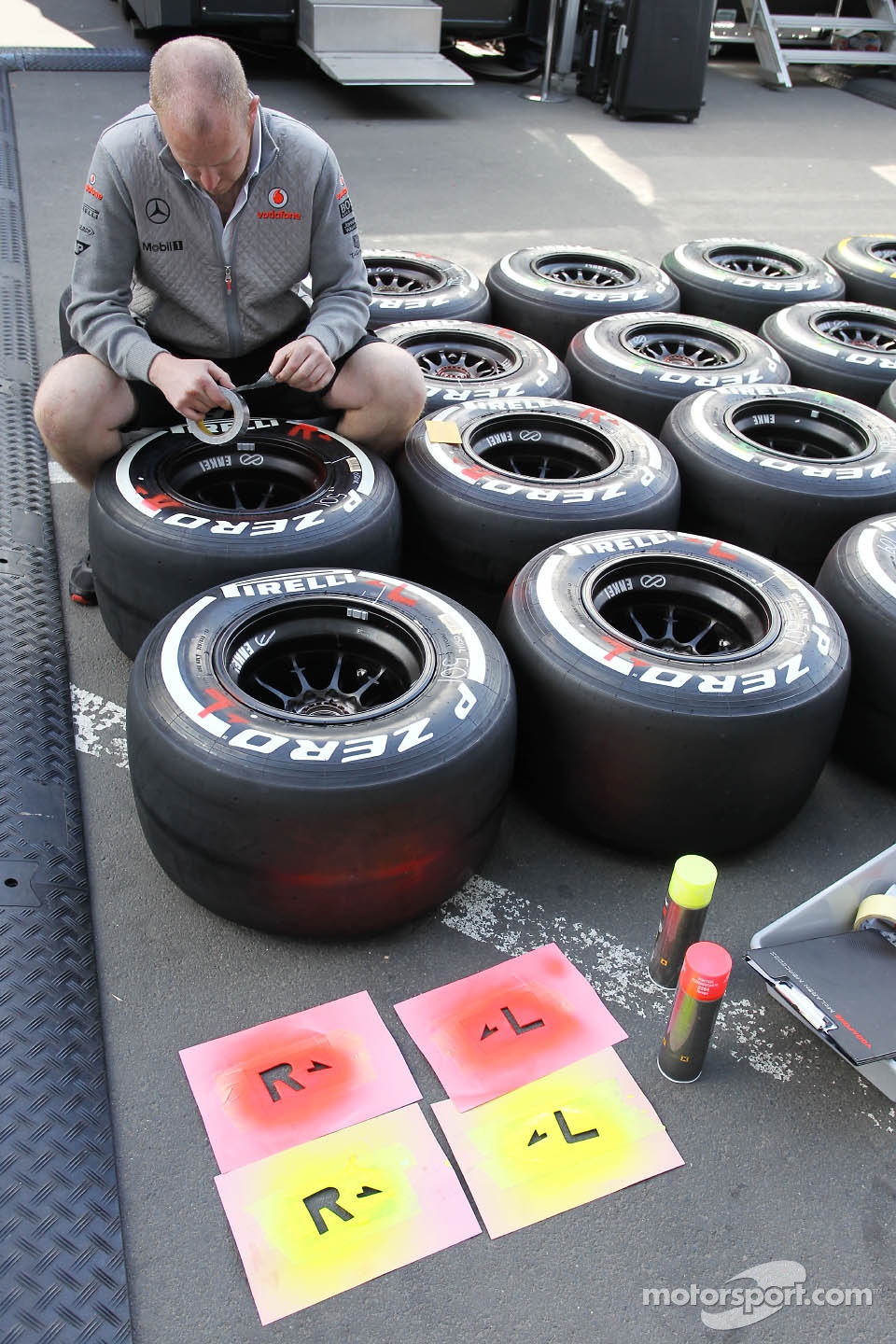
Pirelli tyres prepared by a McLaren mechanic
Source: motorsport.com
Silverstone. What. A. Mess. Up to this point politics had played an unusually minor role in the 2013 Formula 1 season. There had been complaints by the likes of Red Bull and Mercedes, of course, but Pirelli refused to acknowledge that the poor performance of their products constituted a threat to safety. The usual bickering between the top teams rambled on, with the smaller teams looking on in disbelief, but the matter (in Ecclestone and Pirelli's eyes) remained an issue of PR inconvenience. To put it mildly, the race gave Pirelli a lot more to think about than poor advertisement. Six tyres blew up at speeds close to 190 mph, the debris resulting from which nearly killing several drivers, namely Alonso and Raikkonen. "Fernando Alonso is a very lucky boy going home". "We have to assume we have been lucky that no-one has been hurt so far". "We need to do what needs to be done to sort it out". As is evident from these quotes, Pirelli has a lot to answer for. Thankfully, it has been assaulted with questions and enquiries, not that these aren't the norm in today's Formula 1. Worryingly, it appears the construction of the tyre itself is fundamentally flawed. The decision to replace the kevlar belt with a steel one, in conjunction with a substantial reduction in sidewall stiffness, has proven to be a recipe for disaster. As a consequence of the weakness, the teams resorted to an old strategy which involved reversing-mounting the tyres. What this has done is increase pressure on the sidewall, with a view to increasing the life span of the rubber by up to three laps. The problem with this is that the steel to which the sidewall is bound is far weaker than the kevlar used in last year's compounds. Consequently they cannot cope very well with the increase in pressure, which makes them prone to the sort of spectacular blowouts that came to characterise the race at Silverstone. Whilst you could easily blame the teams for reverse-mounting, it seems to be necessary in order to make the tyres last any sort of reasonable distance, a direct consequence of the tyres being too weak in the first place. Who's to blame? Of course, why do I need to ask.

So what's the solution? Simple: revert to using kevlar. Nice and easy. At least now it is, after the greedy execs of Pirelli and Formula 1 management finally admitted that high-speed blowouts might indeed be a slight safety issue, commisioning stronger tyres for the race in Germany (I'm sure the Germans will appreciate their more efficient performance). It's clear that if they had done so earlier they would have dealt with the problem far sooner. Unfortunately, politics got in the way. Again. As Pirelli knew, they would not be able to approve a revision of the stupid design unless they could declare a safety issue. Otherwise, they would have needed to get all the teams to agree- and we all know how successful that would've been. Besides, Pirelli were too focused on bad PR to have the sense to declare an emergency in the first place, a fact which itself presents the most terrifying prospect of the entire saga. They may claim that they had wanted to change the tyres since Bahrain, but the fact is that they were too focused on profit to have the nous to veto all the teams' decisions on the revision process, too business-focused to deny the likes of Ferrari what they wanted in the name of common sense (they must have been taking tips from the FIA, aka Ferrari International Assistance).

I usually don't listen to the doom-mongers who bemoan the death of Formula 1, but it is truly too difficult to ignore their core philosophy. Now, in an era marred by politics and profit-hoarding, Formula 1 is at risk of imploding in a mass of political warfare. One only has to look at how Pirelli have dealt with this situation to understand how politics are ruining the essence of what makes Formula 1 great: combat politics with politically-controversial solutions (*cough*illegal tyre test*cough*). That's sure to work a charm. If Mr Ecclestone and Mr Hembery hadn't been so hungry for profit, racing would be more exciting and would pose much less of a threat to the people involved, who in years gone by were revered for racing their hearts out. Now, they just seem to line pockets. Think carefully about where you want this sport to head, Bernie. Just ask yourself: are you a petrol-head, or a block-head?

26 April 2013

A masterclass in style: Ferrari and the Formula 1 game

Race winner Fernando Alonso, Ferrari F138 celebrates in parc ferme
Source: motorsport.com


F1 drivers are often known by certain character traits- Hamilton is aggressive, Button is collected, Vettel is rapid, and Kimi is... well, he's Kimi. And then there's the likes of Fernando Alonso. Alonso is a wily old fox and has been in this business for a long time; he understands the F1 game and how it should be played. Nowhere was this more apparent than in Shanghai, laying his cunning genius bare before all. He had set his eyes on victory the moment he stormed past Raikkonen before the first corner of the race, slicing his way through the field after every perfectly-executed pitstop and eventually finding himself in the lead for the umpteenth time shortly into his last stint. He was pulling away from Raikkonen in 2nd sometimes at the rate of seconds per lap, and when told by Andrea Stella (his race engineer) to rein in his charge a bit all he said was: "I'm not pushing". Well played, Mr. Alonso. Well played. He was under pressure from a resurgent Massa threatening to be the first of his team mates to out-qualify him five times on the trot on the back of a DNF going into the race, but assumed the role of captain killjoy by qualifying two places in front. To make a further point, he seamlessly ambled past Raikkonen at the start, sailed past Hamilton for the lead on lap five, had the race under control well before half-distance, left Vettel's Red Bull and Raikkonen's Lotus for dead, and greeted the chequered flag eleven seconds before anyone else. Point made, I think.

There were several keys to the Ferrari's success that came together to seamlessly unlock their weekend: amazing speed and durability on the option tyre; second-row qualifying position; bolting off the line; and brilliant race pace. As countless analysts have pointed out, the typical Ferrari affair of recent years involves achieving a respectable-but by no means astonishing-qualifying position, and relying on the consistency of their beloved Spanish hero and, failing that, the car to boost their race prospects come Sunday. Ferrari executed their weekend perfectly, bringing a strategy to the table that would complement all that was good in the car-its excellent tyre management (as emphasised by Alonso's and Massa's cars easily being able to do an average of 16 laps on the medium compound tyre whilst being able to knock out several fastest laps) and the remarkably superior performance on the soft compound tyre. Both factors came together to ensure a good qualifying performance whilst allowing both cars to extract the longest life out of their speedy option tyres at the start of the race. Consequently, they could lead going into the first round of pitstops and carry that momentum into the coming stints, executing the undercut well and leapfrogging those who decided to start on the medium tyre (notably Vettel and Button) and those on the options who couldn't quite cut Ferrari-strength mustard (Hamilton and even Raikkonen). So, that's Ferrari's China success in a nutshell. But what about the other teams?

Red Bull seemed to have a bit of a dismal weekend, epitomised by Mark Webber's woes. Starting in 22nd place wasn't ideal in the first place, but crashing into the sister team on lap 15 was only the start. The end came shortly afterwards, on lap 18, with Webber's wheel ominously migrating across the track towards an approaching Vettel and missing by just a foot. No wonder he looked so disappointed. Despite escaping Webber's attempt at lethal sabotage, Vettel's strategy didn't pay off in the end. Opting for an inverted/alternative tyre strategy was a lucky punt at best, and was not likely to work given the pace of that Ferrari on the options. They had to go to the extent of sacrificing qualifying for both cars in order to start on the mediums, pinning their hopes for victory on all the others struggling on the options. Most indeed did, but not to the extent they were either expecting or praying for. They couldn't get their one-lap pace sorted out in qualifying, and couldn't go fast enough on the tyres they elected to use to build up a big-enough gap to Alonso following his first stop on lap 7. Similar woes were experienced with the Lotus crew, as Kimi's start procedure went awry and following up with a crash into the back of Perez on lap 16. The Mexican was clearly to blame, as was made evident by what I'm sure was a stream of several and quite sour expletives emanating from the Finn's cockpit. I don't believe that this race was a portent of things to come; Red Bull and Lotus experienced a series of unfortunate events throughout the weekend, which merely served to accentuate what was a perfectly executed weekend for Ferrari. It's no more than that, but it does send out a potent warning that Ferrari can, and will, mean business for the foreseeable season. I hope so, Red Bull need knocking off their perch once in a while.

Mercedes. They are somewhat unfathomable at the moment. They exhibit frequent flashes of inspired brilliance in qualifying - epitomised by Lewis' storming lap to steal pole by an emphatic margin -, but come race day they are often left floundering for position. Lewis and Nico mean business when they are given the chance, and both are nigh-on impossible to crack when they are on form. But their race pace... what on earth is the problem? The Mercedes outfit has been burdened with insufferable rear tyre wear since their inception in 2010, a problem they have not found the solution for in four seasons of racing. With the personnel and resources they have at their disposal, I think the persistence of this chronic problem is fairly appalling and largely inexplicable; their car is a bit of an enigma when it comes to this tyre wear. Hamilton and Rosberg cannot maintain an attacking driving style in race conditions without wearing out their car's shoes, which is easily the most detrimental handicap they could have when presented with the formidable challenge brought forward by the usual suspects of Red Bull, Ferrari and now even Lotus. As Red Bull have discovered on numerous occasions, especially in 2010 I seem to recall, blistering qualifying performance alone does not make the formulation for a successful car. Race pace, now more than ever, is crucial, and it is something that Mercedes need to crack if they want to keep their most recently acquired asset happy and fighting.

I have to mention Toro Rosso's performance. Daniel Ricciardo was absolutely stunning throughout the weekend, girding his loins fully on the Saturday. Let's cut to the chase: he was 1.2 seconds faster than his team mate in qualifying 7th on the grid. You read that right, 1.2, and 7th. He then proceeded to outclass Vergne in the race, holding on to his 7th place with an inspired strategy choice and crossing the line where he started. With Mark Webber potentially leaving for Porsche's brand new LMP1 racing team next year, Ricciardo will be going hell-for-leather to grab his seat, and if he carries on at this rate he'll be high up on the list of prospective replacements. The next most comprehensive intra-team trouncing with regards to quali and race performance was offered by Nico Hulkenburg in his Sauber, a second ahead of his team mate Esteban Gutierrez, who seemed to resemble something akin to a kamikaze mobile chicane more than anything else. He crashed into the back of Adrian Sutil in a spectacularly amateurish maneuver on lap 4, rather a good metaphor for his disappointing performance so far this season, having been outclassed by his team mate at Malaysia (and probably in Australia had Hulkenburg been able to start the race). Hulkenburg had a stonking race, running with the big guns for a while in the middle of the race and racing Vettel for position. Of course he himself was a mobile chicane in the eyes of the world champion, but considering the Sauber is nowhere near as quick as that infernal Red Bull he did very well to keep ahead of it and finish 10th to get some points for the team. The same can't be said of his young Mexican team mate, who will seriously have to up his game if he wants to impress the Sauber heavies. Even Sergio Perez in his new McLaren outfit is failing to impress. He seems to be taking things far too cautiously at the moment, and needs to take a more aggressive attitude, the kind that secured him his dream drive in the first place. I'm sure Martin Whitmarsh has told him this, but he really does need to get a move on to justify his position in the team.

Despite being a fairly innocuous weekend compared to the cataclysmic battle in Malaysia, Ferrari have managed to send out an ominous message to the front-running few. They can occasionally get everything right in a race weekend, and when they do, you can be sure as hell they will do themselves justice.

14 April 2013

Schumacher Mark II?: Vettel and the determination to dominate

Podium: race winner Sebastian Vettel, Red Bull Racing, second placed Mark Webber, Red Bull Racing
Source: motorsport.com


Sebastian Vettel is secretly a ruthless driver. Behind the intelligently-cultivated facade of the cheerful young German lies a relentlessly competitive individual, willing to do anything within his power to achieve success. Vettel the Emulous has been likened to that other mercilessly competitive German hero of days gone by, the legendary Michael Schumacher, who incidentally is his chief sporting idol having known him from a young age. Such a comparison has been criticised by the Vettel faithful (not least by his Red Bull champion Dr Helmut Marko), but after the events of three weeks ago few would be able to deny the similarities.

Red Bull had the Malaysian GP in the bag in the run up to the last round of pit stops, with Mark Webber leading on the medium compound tyre by a comfortable 4.6 seconds on lap 40 and a rapidly approaching Sebastian Vettel in second. Webber pulled into the pits on lap 44 for a set of the hard compound tyres. He emerged from the pit. His team mate was right beside him. A furious battle for the lead ensued, with the pair almost crashing at the end of the pit straight on lap 46, Vettel executing a move eerily similar to one seen in the infamous Schumacher-Barrichello incident at Hungary in 2010. Vettel did not cease in his relentless attack on Webber, and eventually passed him on the exit of turn four. The chequered flag fell. Vettel won from Webber by 4.3 seconds. The atmosphere in the pre-podium was unusually muted as Webber entered, seemingly oblivious to Vettel's presence. Vettel said "Mark", but received no reply. Webber seated himself, looked at Vettel and said three words: "Multi-21, Seb. Multi-21". This confirmed for the millions watching what they had come to suspect following the reaction on the Red Bull pit wall to the horror unfolding before their eyes: a team order had been executed, and Vettel had ignored it.

Post-race inquisition from hungry journalists revealed that tyre wear had been the primary concern for Red Bull going into the race, with running throughout the weekend showing up how worryingly hard the RB9 was on its tyres. Such was the team's concern that they devised a strategy focused around the coded messages "Multi-12" and "Multi-21", designed to tell the drivers to hold position should car number one be in the lead and number two in second and vice versa. When the call came to execute Multi-21 after that fateful last pitstop, Webber turned his engine mode down, believing that the race was over. In Vettel's eyes it wasn't- he left his engine mode where it was and attacked Webber. After the race he claimed to have "misunderstood" the order and thus failed to take appropriate action, but this is highly doubtful. Vettel is intelligent, and the language used was explicit in its desired intentions; he knew exactly what he was doing. The decision to defy his employers' orders has revealed a lot not only about himself but also about the balance of power within Red Bull. Christian Horner was asked why he didn't order Vettel to give the place he had wrongfully taken from Webber back, and whether he even attempted to. His reply was cold, almost pathetic: "there was no point. He'd made it quite clear what his intention was by making the move. He knew what the communication was . He chose to ignore it". What sanction has this ignominious behaviour quite willingly acknowledged by Red Bull drawn? As of right now, absolutely none. This has understandably angered a certain 36 year-old Australian, who had publicly acknowledged Vettel's usual internal "protection" on the Sepang podium. Webber seems to have felt so betrayed by his team mate that he has apparently begun a search for a seat in endurance racing for next year. To add insult to injury, Vettel announced in the Thursday press conference this race weekend that he was "not sorry for winning", and that he would "do it again" given the chance. Again, this seems eerily similar to Michael Schumacher in his attitude towards trying to drive Jacques Villeneuve off the track in the title decider at Jerez in 1997 and his obstruction of Alonso in Monaco qualifying in 2006, both of which to this day he has not apologised for. It appears, then, as if the three-times world champion is another force that cannot be stopped, only that this time not even his own team can control him.

Following this cataclysmic reawakening of the Vettel vs Webber saga, one could be forgiven for believing that all German drivers were burdened with the dominate-at-all-costs attitude. However, as one Nico Rosberg proved in the same race in the same situation, such a belief would be unjustified. The difference between his and Vettel's behaviour in an almost identical situation can only be described as striking. Rosberg found himself in fourth place behind his Mercedes teammate Lewis Hamilton in the closing stages of the race. He was catching him quickly, much like Vettel was with Webber. Similarly, the call came across Rosberg's radio to hold station behind Hamilton. He questioned this call several times, stating how he was "so much faster" than his new teammate. His inner competitor was straining against the shackles, but the authoritative voice of Ross Brawn came to quell the urge: "negative Nico, negative." You could almost hear Rosberg screaming "WHY?!" down the radio to his team principle. So could Brawn: "Nico, Lewis' pace is what we are asking him to do. He could go a lot faster, too." So, here we had two top teams faced with excessive tyre wear and a shortage of fuel. Both their drivers were told to cease racing and bring themselves home in the order they were in. The difference? Nico Rosberg magnanimously and respectfully held position behind his teammate. Hamilton was seen clasping palms and hugging Rosberg immediately after the race, and heard by many in his podium speech, finishing with an emphatic statement: "I feel that Nico should be up here." Nico reciprocated: "I wouldn't say they owe me one because I understand." Mercedes thus appears to enjoy a stable working environment founded on an unshakable bond of friendship shared between their two drivers, teammates in karting and neighbours in Monaco. Hamilton fondly recalled in an interview how in the run-up to Christmas in 2012 he returned to his flat with no food, and how Rosberg and his girlfriend offered to make dinner for  him. Such a strong bond may become strained in the ruthless world of Formula 1 and they may fall out in a manner similar to Vettel and Webber and Schumacher and Barichello. But for now, Mercedes look like they have it all under control, ready to take on the title challenge.

Perhaps the most important thing revealed by this stark contrast is that Red Bull is now unquestionably, irrevocably, absolutely Sebastian Vettel's team; Horner's authority appears subject to his will, and the "protection" enjoyed by the world champion has been laid bare in typically Webber-esque fashion. In a team like Ferrari, where Fernando Alonso's contract is widely known to preclude any notion of his teammate having 'number one' status, such a one-man-band philosophy works. While Felipe Massa is undeniably quick, having recently rediscovered his 2008 form, he has an inherently innocent and meek character, able to be manipulated easily: he is the perfect number two driver, able to support his teammate with plentiful skill as and when required. This has been shown as recently as Malaysia, relinquishing his place to Alonso within one corner of the race starting. This does not apply to Webber. He has a strong character and takes no prisoners when the red mist descends. He is inherently rapid and feels that he should be handled as such. He does not play second fiddle to anyone either without a fight or letting everyone know about it. "Not bad for a number two driver" winning the British Grand Prix in 2010 with an inferior front wing. Quite.

Red Bull's championship challenge could become seriously derailed by this recent turn of events. Neither driver will show any contrition in the coming races- they will drive hell-for-leather to show each other who's boss. In his Ferrari glory-days Schumacher held the team's gun to Barrichello's head, ready to fire should he not be willing to cooperate. Ferrari is exactly the same today. Mercedes, on the other hand, currently enjoy an undisturbed peace. They both can and will design an effective championship challenge that will last. Vettel is in a similar situation to Schumacher, except that Webber has his finger on the trigger too. Should they both pull it, Red Bull's success will be turned on its head.

21 March 2013

A cool man in a hot country: Kimi and his easygoing attitude

Race winner Kimi Raikkonen, Lotus F1 E21 celebrates at the end of the race
Source: motorsport.com


Well, there we have it. The first race of the 2013 Formula 1 season has come and gone. Despite perhaps not being the most epic of races in recent memory, it certainly served to confirm what we have all come to realise: expect the unexpected. Kimi Raikkonen's win didn't exactly come out of nowhere considering the pace the Lotus Renault E21 showed in winter testing, but the likes of Red Bull, Ferrari and even Mercedes had the benefit of qualifying to boost their prospects, with those teams occupying the first three rows on the grid. Red Bull even managed to lock out the front row and did so by a worryingly significant margin, with Sebastian Vettel securing his place at the very front by an eye-watering six tenths (in front of the next non-Red Bull).

In true 2013 fashion, the race did not conform to the order established by qualifying. The Red Bull of Sebastian Vettel bolted off the line and built the customary two-second lead, but came to be hunted down by the Ferraris of Felipe Massa and Fernando Alonso and eventually the Lotus of Kimi Raikkonen in the early stages of the race. Raikkonen bailed out and pitted on only lap seven following an even earlier pitstop from Mark Webber, who suffered a horrendous start as a consequence of what appeared to be a failure of the onboard ECU (which interestingly is produced by McLaren Electronics... damage limitation at it's most desperate?). This apparent lack of race pace of the Red Bull was further underlined by the fact that Vettel could not find a way past the Force India of Adrian Sutil for ten laps, who took the lead on lap fifteen having been able to exploit the friendliness with which his car used its tyres. Bearing in mind that Di Resta managed to make his way through the field on a similar (but ultimately better-executed) strategy to Sutil, one could say that it was the inherent ability of the Force India to preserve its tyres very well in conjunction with its astonishing straight-line speed that meant that Vettel couldn't get past. Whilst this may be true, there are more factors at work. Vettel had to react to Webber's pace on lap twenty two-incidentally at the same time as Sutil's first stop-as a consequence of the new mediums that he had acquired on lap nineteen, underlining the fact that the car could not perform on tyres that were more than twelve or thirteen or so laps old. The fact that these were medium tyres is particularly worrying for the team, with Horner blaming the unexpectedly-cool track temperatures causing the tyres to work improperly. Is this cause for concern? Yes. But, if any team can get on top of it quickly, it's Red Bull.

What is more concerning for Red Bull is the superior ability of the Lotus and to a lesser extent the Ferrari to manage their tyres. Kimi Raikkonen was the only one of the front-runners able to pull off a two-stop strategy, with the Mercedes of Lewis Hamilton and Nico Rosberg both failing rather spectacularly: the number 10 car wrecked its mediums in a lock-up on lap thirty one following a tussle with the charging Ferrari of Alonso, and Rosberg made an unfortunate exit on lap twenty seven. Having failed to note the fact that their cars couldn't last as long on the super-softs as the Lotus and Ferrari in the first stint, Mercedes mucked-up their strategy-something they'll need to look at by the time the F1 circus arrives in Malaysia. Anyway, back to Lotus/Ferrari. Raikkonen made a storming start from P7 on the grid, pitting on lap ten at the same time as Alonso (whose tyres looked in noticeably worse condition than the Flying Finn's) and continued to go from strength to strength, eventually taking the lead on the twenty-third lap and re-taking it again from the impressive Adrian Sutil ten laps from the end. The constant swapping of leaders up to this point indicated that both Lotus and Ferrari were capable of winning, but after Alonso overtook the struggling Sutil on lap forty six, he couldn't keep up with Raikkonen, who seemed to be able to set blisteringly-fast lap times and even pull out a lead without damaging his tyres too much-no wonder he said it was an 'easy' win. Alonso said he was 'worried' by the pace of the Lotus. Considering the fact that they now have Red Bull know-how in the form of Mark Webber's former race engineer Ciaran Pilbeam, I think he certainly should be.

Despite this, the Ferraris did look very quick in their own right, as demonstrated by both the cars' ability to rein in Vettel at the beginning of the race due to better tyre management. Alonso set a series of fastest laps before and even after Raikkonen's last stop on lap thirty four, and was only prevented from maintaining the lead by his third and final stop in the closing stages of the race. Even though they ultimately couldn't manage their tyres as well as Raikkonen in his Lotus, Ferrari have much to be pleased about. Last year they were nowhere despite their shock win at a drenched Malaysia. They have come on leaps and bounds since then, and have maintained the amazing form they showed in the latter parts of the 2012 season by giving both Alonso and Massa the chance to challenge for wins from the off. The warmer temperatures at Sepang could shift around the order and allow the Prancing Horse to gain a slight advantage, seeing as they had been suffering from understeer at testing. However, the Red Bull seems to love warmer temperatures, so Ferrari could slip back all the same.

McLaren are the ones who have to worry. They need to take a long, good look at themselves and think hard about what on earth they have done to their car. It's a car far removed from the MP4-27 of last season, with the introduction of a higher chassis, new rear suspension, and a very highly downforce-oriented rear end. All of that should have improved the car, but it hasn't. Something is holding it back. Perhaps it's the simplified approach to the front wing, being a three-element one instead of the more aerodynamically-efficient five-element? I don't know, and I'm not sure McLaren does either. I think it's probably a case of untapped potential, with performance ready to be accessed once all the radical changes can work in harmony. At the moment they all seem to be slightly out of sync, which means that the car is inconsistent and highly unpredictable. Did I mention the fact that it was three seconds off the pace in the dry in Q3? That's worse than the MP4-24 in 2009, and we all remember how awful that was. But, perhaps McLaren can find solace in the fact that they have been in this situation before, and they have bounced back to produce race-winning cars. They're renowned for being able to do this, so I don't see why they shouldn't be able to get on it sooner rather than later.

So, the grand prix down in Oz seems to have told us that tyre management will be a key factor in winning this championship. It's all about getting exactly the right set-up for specific conditions, especially now the tyres are so susceptible to graining. In this light, Lotus seem to be one step ahead of the others. It's a high-quality team with an intelligent bunch of people making sure they get the car set up in exactly the right way. The only thing that might hold them back is a slightly smaller budget. Mind you, one only has to look at McLaren and Force India to see that a big budget doesn't always correlate to the speed of the car. There's hope for Lotus and their easy-going Flying Finn yet.

15 March 2013

Australian GP: The 2013 F1 Season is GO, GO, GO!

Drivers start of year group photograph
Source: motorsport.com

The stage is set. The actors are about to give their first performance. They've learnt their lines, performed their rehearsals and are itching to get their teeth stuck into the piece of drama set out before them. Like all actors, they are unsure of how this first performance will turn out. Such is the situation in the run up to the inaugural grand prix of the 2013 Formula 1 season: the traditionally fun-loving and astonishingly well-attended Australian Grand Prix in Melbourne. Drivers and other team personnel up and down the paddock know all too well the atmosphere generated by these traditional features of Albert Park; indeed, it's probably why it's traditionally seen as such an exciting and engaging race. The excitement will undoubtedly reach new heights this year, as it seems that the air of uncertainty usually pervading around the paddock at this time is greater than in recent years. Following an interesting set of tests at Jerez and Barelona (to say the least), not even the usual suspects of Red Bull, Ferrari, McLaren, Mercedes and Lotus can be distinguished to a meaningful extent; the teams' running provided us with a delectable set of numbers largely too jumbled to make sense of.

Perhaps the heightened uncertainty has been caused by the shock of one of the few trends identified during winter testing: the unexpected turn of speed that the Mercedes car seems to have acquired. As I'm sure everyone knows, that Merc car achieved a couple of blisteringly fast times around the turns of Catalunya in the hands of both Lewis Hamilton and Nico Rosberg, in both cases outrunning the next-fastest man by at least three tenths of a second. No matter how much Lewis insists on the amount of work Mercedes still needs to do after such a difficult 2012 campagin-which admittedly saw them two seconds off the race pace and an eye-watering nine tenths off the qualifying pace by Brazil-we all know that it has done a herculean job over the winter to catch up to the front runners. The front wing design seems to have been developed hugely over the winter, maturing from the rather simple three-element design on the W03 2012 car to the elaborate five-element one introduced at the first Barelona test. Assuming what we can from winter testing, they've got the design right. The increased complexity of the front wing seems to have eradicated the understeer that plagued the W03 by increasing downforce levels at the front of the car. This itself seems to reflect the management changes undertaken at Mercedes, with high-flying motorsport boss Norbert Haug being ousted in favour of Toto Wolff and the apparent signing of former McLaren technical director Paddy Loewe for 2014 rendering Ross Brawn's role as team principle now defunct. One can only hope that these changes mean that Merc will be able to keep up a competitive development programme throughout. If they don't, I'm sure a certain Lewis Hamilton will have something to say about it.

Similarly as unexpected as the Mercedes turnaround has been the apparent sluggishness of the new McLaren MP4-28, whose predecessor largely showed very promising signs during winter testing over all three tests preceding the 2012 season. De-facto team leader Jenson Button and even team principal Martin Whitmarsh have admitted that they are "slightly concerned" over the situation of their new charger. Largely the issue lies in the fact that the design of the car is too complicated and too far removed from the MP4-27 for the team to  get a firm grip on, which seems to be demonstrated perfectly in the up-and-down success of the car in longer runs. Some have said that the main problem is inherent understeer caused by a lack of downforce on the front wheels (perhaps caused by a botched attempt to counter the disadvantages of their new pull-rod suspension, which does not often work well with high-nosed cars due to an inability to get necessary components low enough in the chassis to improve handling). In light of this I would say that the resultant inconsistent performance is most likely due to changeable nature of European winter conditions and the subsequent effect that this would have on tyre performance/grip. This was most notable in Barcelona, which saw track temperature highs of 30 degrees on one day compared with an air temperature of less than 10 on others. Despite this it is impossible to truly determine their current form until they get onto a warmer track such as Melbourne, where the new and notoriously degradable Pirelli tyres for 2013 can get up to their proper working temperature and help that poor MP4-28 find some front-end grip... that is until the tyres decide to 'fall off the cliff', which the supersofts will do after approximately six racing laps.

These two teams alone have upset trends of recent years, and seem to have got teams worrying as to where they stand in the pecking order; clearly, previous notions of where a team thought they were may not apply at all. What other trends we've been able to establish so far indicate that Ferrari and Red Bull (both of which I shall discuss later) seem way ahead of the poor McLaren and are on a par with the impressive Mercedes, maybe even a bit quicker. Will the first two free practice sessions of the new season finally dispel the cloud of mystery that has gathered around these top teams? Or will they merely keep us guessing until the cars form up on the grid? I say roll on Sunday, this new uncertainty is killing me.

13 March 2013

Welcome to the 2013 Season

Hello fellow Formula 1 fans,

Welcome to what is my first attempt at this whole blogging thing- I hope I get at least some of it right! As an aspiring journalist studying history at the University of Exeter, I couldn't think of a better place to start writing- nor could I think of a subject more worth writing on than one of my life-long interests.  Presuming I do get some of it right, I ask you to join me as a fellow Formula 1 fan on this upcoming ten-month roller coaster.  I will be writing in-depth posts at intervals throughout the season, writing on the biggest issues in the world of Formula 1 and providing my humble (if sometimes slightly biased) opinion.

The 2013 season promises to be one of the closest yet. Winter testing in Jerez and Barcelona hasn't exactly resembled the usual pre-season affair of recent years, with the unlikely pacesetters of Mercedes turning many a head in the paddock, McLaren having done a 'Ferrari' in creating a mind-bendingly complex car, and Red Bull looking surprisingly far down in the list of fastest times, with Sebastian Vettel and Mark Webber being placed 12th and 16th respectively. Of course, there is only so much one can infer from the notoriously enigmatic phenomenon of pre-season testing. But, one cannot deny that what has thus far transpired has thrown up a few potential dark horses for podiums, wins, and even the world championship. What does the 2013 season hold for us? Well, join me in finding out.

xxJSGC123xx